
Labels that stay on in the freezer
From frozen food cases to liquid nitrogen storage, ordinary labels lift, curl and smear in the cold. We match the adhesive, facestock and finish to your storage conditions, then send samples to test before you commit to a run.
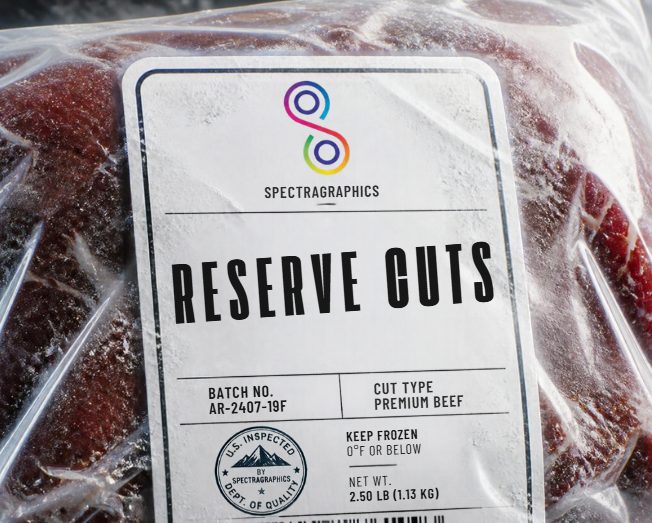
Two constructions, rated for the cold
Spec sheet at a glance
These are the two constructions we use most. We can adjust the facestock and finish for your container and artwork.
| Spec | Cold-temp hot melt | Cryogenic acrylic |
|---|---|---|
| Best for | Frozen and refrigerated food packaging, cases and cartons | Lab vials, test tubes, well plates and slides in deep freeze or liquid nitrogen |
| Lowest application temp | 10°F (-12°C) | -20°F (-29°C) |
| Service temp | -50°F to 145°F (-45°C to 62°C) | -320°F to 194°F (-196°C to 90°C) |
| Surfaces | Corrugate and a wide range of packaging materials, including wet and oily or greasy surfaces | Polypropylene vials and slides, glass, stainless steel, HDPE. Not for glass vials under liquid nitrogen. |
| Facestock | Paper or film, chosen for your package | 2.3 mil white polypropylene film, topcoated for flexo and thermal transfer printing |
| Holds up to | Freezer storage, condensation and handling | Dry ice, steam autoclave, gamma sterilization and many lab chemicals |
| Peel adhesion, stainless | 2.3 lb/in | 2.0 lb |
Typical values from manufacturer data sheets. Hot melt values were measured on 60# semi-gloss paper at room temperature; service temperature also depends on the facestock and the surface. The cryogenic construction was tested through repeated cycles at -94°F and in liquid nitrogen. Always test samples on your own containers before production.
Four ways cold storage beats a standard label
Adhesive stiffens
General-purpose adhesives lose tack as they get cold, so edges lift and labels fall off in the case.
Frost and condensation
Moisture on the container blocks the bond, especially when products are labeled already chilled.
Paper soaks through
Uncoated paper absorbs moisture during thaw cycles, wrinkles and tears.
Print scuffs
Lot codes and dates rub off in handling unless the print and finish are protected.
Every layer chosen for the cold
A freezer label is a system. We spec each part for your container and your storage conditions.
Freezer-grade and all-temperature adhesives
Chosen for both the temperature at application and the temperature in storage.
Film and moisture-resistant stocks
Film options that hold up to frost, thaw and handling without wrinkling or tearing.
Varnish and laminate protection
Protects graphics and required text from scuffing in cases, trucks and freezer aisles.
Room for lot codes and dates
Labels built to accept your in-house coding, or printed with variable data before they ship.
Built for frozen and cold-stored products
Four answers that decide the right label
Have these ready and we can recommend a construction on the first call.
How cold is the container when labeled?
Room temperature, chilled, or already frozen.
Where does it live afterward?
Refrigerator, standard freezer, ultra-low freezer, or liquid nitrogen.
What is the container made of?
Plastic tub, film bag, corrugated case, glass, or metal, plus its shape.
Is the surface wet or frosted?
Condensation, frost, ice glaze, or thaw-and-refreeze cycles.
From samples to production
Tell us your conditions
Share your product, container and temperatures using the form below.
Test samples
We send label stock to try on your containers in your own freezer.
Approve a proof
We prepare your artwork and send a proof for sign-off.
Print and ship
Your labels are produced and shipped, ready for repeat orders.